roasters-coffee-content
Coffee Content
Roasters Book Page 51
Source Image: ../images/shift-book/roasters-book-51.JPG
Coffee Quality Testing and Production
At every stage of its production, coffee is repeatedly tested for quality and taste. This process is referred to as ‘cupping’ and usually takes place in a room specifically designed to facilitate the process. First, the taster – usually called the cupper – carefully evaluates the beans for their overall visual quality. The beans are then roasted in a small laboratory roaster, immediately ground and infused in boiling water, the temperature of which is carefully controlled. The cupper “noses” the brew to experience its aroma, an integral step in the evaluation of the coffee’s quality. After letting the coffee rest for several minutes, the cupper “breaks the crust” by pushing aside the grounds at the top of the cup. Again the coffee is nosed before the tasting begins.
To taste the coffee, the cupper “slurps” a spoonful with a quick inhalation. The objective is to spray the coffee evenly over the cupper’s taste buds, and then “weigh” it before spitting it out. Samples from a variety of batches and different beans are tasted daily. Coffees are not only analyzed this way for their inherent characteristics and flaws, but also for the purpose of blending different beans or determining the proper roast. An expert cupper can taste hundreds of samples of coffee a day and still taste the subtle differences between them.
Roasting
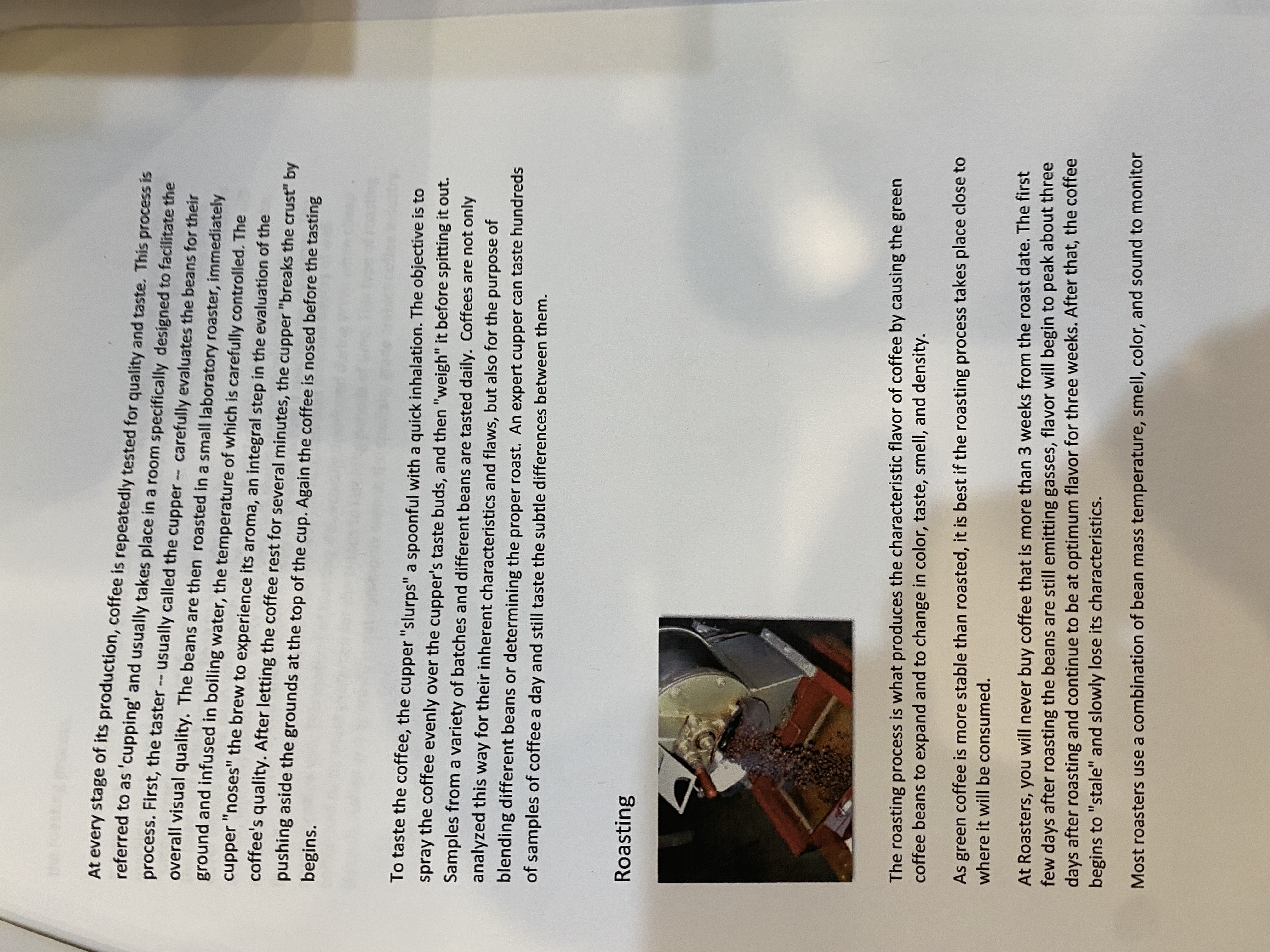
The roasting process is what produces the characteristic flavor of coffee by causing the green coffee beans to expand and to change in color, taste, smell, and density.
As green coffee is more stable than roasted, it is best if the roasting process takes place close to where it will be consumed.
At Roasters, you will never buy coffee that is more than 3 weeks from the roast date. The first few days after roasting the beans are still emitting gasses, flavor will begin to peak about three days after roasting and continue to be at optimum flavor for three weeks. After that, the coffee begins to “stale” and slowly lose its characteristics.
Most roasters use a combination of bean mass temperature, smell, color, and sound to monitor